Busan is turning to the Arctic to strengthen its position as a global maritime hub. From trialing polar shipping routes to building new icebreakers, South Korea is venturing north. But can the country’s Arctic ambitions transform the fortunes of its biggest port?
Walking through the streets of Busan, South Korea’s second-largest city, initially feels like strolling through a vibrant and modern metropolis. Coffee shops on every block serve up trendy drinks like brown sugar lattes and sweet potato frappes, with posters featuring fresh-faced K-pop stars. Tourists sunbathe on golden beaches dwarfed by silver skyscrapers. On the shorefront, as towering container ships sail in and out of the port, fishermen in rubber boots haul in their morning catch to sell at the bustling seafood market.
But scratch beneath the surface, and Busan has seen better days. The population is aging and graying – a phenomenon I witnessed while riding the bus one bright September day sandwiched between dozens of senior citizens. For decades, the young and upwardly mobile have moved north to Seoul for school and work, leaving the seaside city to become South Korea’s first major “super-aged” metropolis in which more than 20% of residents are over 65.
As I was getting a haircut in the shopping district of Seomyeon, my 20-year-old stylist complained that Busan was boring, offering little to do. I suppose it’s all relative, though, as the neon alleys seemed bustling to me. Young men played card tricks for passers-by, couples lingered in the fluorescent glow of convenience stores, and street vendors sold late-night snacks like hotteok: freshly fried pancakes oozing with melted brown sugar and cinnamon. Still, another woman I spoke to in her late 30s, originally from Seoul, noted that her hometown enjoyed a higher quality of life and better infrastructure, and that she had only moved south to Busan for a job. Once that wraps up, she admitted, she would hurry back to the capital. Even the world’s youth are flocking to Seoul, with the Financial Times calling it “the new Paris for university students living abroad.”
The success of Seoul, whose metropolitan area contains over 50% of the country’s population, is such a problem that in 2007, the national government began building a new administrative city, Sejong, 150 kilometers to the south to try to attract talent and capital to a different part of the country. Yet the initiative has not reversed Seoul’s dominance, for the capital’s proportion of the national population has only grown since then.
To bring life back to Busan, then, the government is not scouting elsewhere within its 100,000-square-kilometer country. It is venturing all the way to the Arctic.


South Korea incorporates the north
To revive Busan, South Korea’s main port and one of the biggest in the world, the South Korean government intends to use the whole of the Arctic as a thoroughfare. This might seem like a wild proposition, but Busan is already the world’s seventh-largest container port and second-largest hub for transshipment, or unloading goods from one vessel before reloading them onto another to continue to their final destination. Arctic shipping even became an election issue last year, when presidential candidate Lee Jae Myung, who went on to win, urged South Korea to venture into Arctic shipping to bolster national energy and trade security.
In May, South Korea’s National Assembly passed the Special Act on the Promotion of Arctic Route Utilization and the Development of Related Industries, which will come into effect this December. The legislation will establish government committees to oversee the development of polar shipping and shipbuilding, develop Arctic expertise, technology, and regulatory frameworks, and transform Busan and its surroundings into a polar logistics hub.
Already, several South Korean shipbuilders have experience building ice-class vessels. Just south of Busan in Gyeongnam, between 2016 and 2019, Hanwha Ocean built 15 ice-class liquefied natural gas (LNG) carriers for Russia’s Yamal LNG facility. Hanwha also built six ice-class LNG tankers for Russia’s Arctic LNG 2 project, but sanctions prevented the ships from being delivered. Arctic LNG 2 has now filed a $1.02 billion arbitration claim against Hanwha at the Singapore International Arbitration Centre. At its shipyard in Ulsan, located between Gyeongnam and Busan, HD Hyundai Heavy Industries is building an icebreaker for the Swedish Maritime Administration – arguably a much safer client than a Russian gas company.
Korea Maritime Institute: turning the world upside down
Last week in Busan, I visited the Korea Maritime Institute, a government-funded research center that supports national policymaking for maritime affairs, shipping, and fisheries. One of its blog posts in 2019 contended that South Korea “is a natural strategic location for maritime expansion, serving as a port type nation that advances into the sea using China and Russia as hinterlands.”
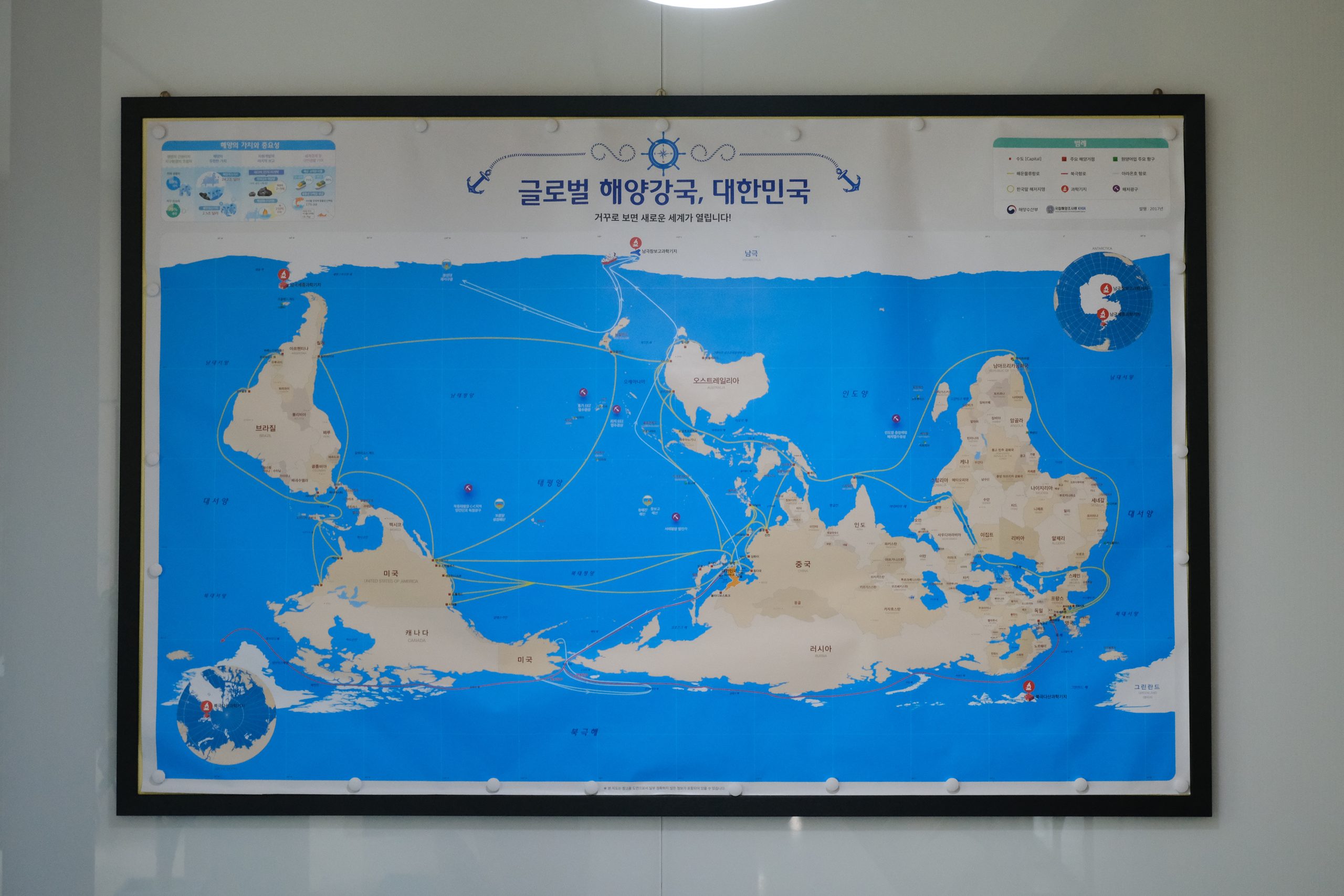
It’s funny to think of the world’s second-largest economy and largest country, respectively, as mere Korean backyards. A map hanging in the lobby at KMI helps put this geography in perspective. Published in 2017, the “Inverted World” map emphasizes oceans over land and places the Korean Peninsula at its center. (A high-resolution version of the map is available here).
An earlier version made in 2007 by a marine policy expert named Gil Kwang-soo similarly turned the typical map of the world upside down and stuck Korea in the middle. Yet as the Ministry of Oceans and Fisheries explains in its blog, “This map did not depict the Antarctic continent and the Arctic Ocean in detail, which are attracting attention as new maritime territories.”
The updated cartography pulls the polar regions into South Korea’s orbit. It also includes details like the locations of Korea’s polar research stations in the Arctic and Antarctica, and the various routes used to reach these far-flung destinations. KMI’s 2019 blog post adds, “With the Korean Peninsula at the center, the vast Pacific Ocean stretches out in the middle of the map, capturing Korea’s enterprising maritime policy of expanding into the world through sea routes.”


The “Inverted World’s” inset map of the Arctic featuring South Korea’s research station in Svalbard.
Busan: Developing not one, but three Arctic shipping routes
Busan may be struggling as a city, but as a port, it is doing well by capitalizing on its strategic location. Over half of its throughput comes from transshipment. Manufactured goods from factories in northeast China near cities like Dalian and Qingdao often make their way through Busan on their way to Japan. Cargo going between Southeast and Northeast Asia also often passes through. So, too, do goods from North America, which reach Busan via the Great Circle Route across the top of the Pacific Ocean.
But in a competitive regional environment, with ports in northeast China vying for transshipment cargo, Busan has to stay on top of its game. That means operationalizing the Arctic not just as a place to enter, but as a collection of routes whose development promises to make South Korea’s ports more vibrant and important.
To improve Busan’s fortunes, the South Korean government is pursuing three strategies. First, the country is trying to position Busan as a key port for all three emerging Arctic shipping routes. Seoul’s interest in developing what might be called the polar triad sets it apart from Beijing’s greater focus on partnering with Russia to develop the Northern Sea Route (NSR). Still, the NSR is the primary target for South Korea, too. Climate change is melting sea ice and making the passage, which is 30 to 40% shorter than the typical distance between East Asia and Europe via the Suez Canal, accessible for longer periods each year.
Longer term, South Korea has its hopes pinned on the Northwest Passage and the Transpolar Passage – the latter if and when the Arctic Ocean becomes effectively ice-free in September, defined as having less than one million square kilometers of sea ice, as is predicted to happen by mid-century. Some of the latest science even suggests that the Arctic could experience its first ice-free day by 2030.
Cutting straight across the North Pole, the Transpolar Passage could accommodate ships with deeper drafts and potentially provide a more direct connection to lucrative East Coast ports like New York and New Jersey. These features may make the route more compelling to South Korea’s biggest shipping companies compared to the Northern Sea Route and Northwest Passage.
External climatic and geopolitical factors are already pushing shipping companies to look for alternative routes. In the Panama Canal, the onset of El Niño is exacerbating drought conditions and limiting the number of ships that can pass through its locks. Low-water surcharges have risen from $100 to $320 per TEU, driving up global shipping costs.
In the Middle East, particularly around the Strait of Hormuz, conflict and instability are putting additional pressure on shipping companies to turn elsewhere. Even if they don’t intend to move massive amounts of cargo via the Arctic, in unstable times, having options builds resilience.
Building a northeast Asian maritime hub in Busan
Second, Busan is looking to become a regional maritime service hub akin to Singapore or London for Northeast Asia. This means not only supporting transshipment, but also shipbuilding, repairs, insurance, and arbitration. South Korea’s first specialized Maritime and International Commercial Court is scheduled to open in March 2028 with locations in Busan and Incheon.
With the rule of law under threat worldwide, South Korean officials are emphasizing data-sharing, regulatory cooperation and transparency as part of their approach to Arctic shipping. Even Russia has an interest in this. By working with Seoul, the Kremlin can demonstrate to the world that it is possible for international partners to use the NSR in a controlled and regulated manner. In contrast, working with China merely indicates that the Moscow-Beijing partnership is functional.
Still, even if South Korea can cooperate with Russia, that doesn’t mean other countries will. Japan is hesitant to do so to protect its relations with the US and Europe. For European countries, dealing directly with Russia, which arguably poses a much more direct threat to them than it does to South Korea, is generally out of the question. While Putin is waging war on Ukraine, as I learned from people in Busan, Seoul is interested in keeping the peace in Northeast Asia. South Korea’s overriding security concern is North Korea, not Russia, making cooperation with Moscow and Beijing necessary to maintain a regional balance of power.
Traces of Russia in Busan’s urban fabric
Along Busan’s bustling streets, reminders of South Korea’s proximity to Russia pop up through both tourism and signage. On a bus headed for the seafood market, three young Russian men were chatting animatedly. For visits of up to 60 days, Russians do not need a visa to visit South Korea. Actually reaching the country, however, is a little bit trickier. In 2016, I took a direct flight from Vladivostok to Incheon. But South Korea cut all direct flights with Russia following its invasion of Ukraine in 2022. If they were flying, the three young men would likely have had to transit through an airport in a third country such as China, Uzbekistan, or Turkey.
Alternatively, if they had sufficient time and were coming from the Russian Far East, they could have sailed aboard the Eastern Dream ferry between Vladivostok, Busan’s sister city, and Donghae, a South Korean port three hours north of Busan. Operated by South Korean ferry company DuWon, the route takes roughly 24 hours. One has to wonder how many inquiries DuWon receives, however. While the company’s website has a page titled “FAQs,” it simply reads, “There are no FAQs.” (For inquiring minds curious about this ferry, two intrepid New Zealanders wrote a blog post documenting their passage in December 2016).
Once in Busan, Russians would see something familiar in the Cyrillic signs touting everything from dried seafood to “1,000 trifles.” Many of these are relics of the 1990s, when Russians formed the second-largest group of foreign visitors to Busan after the Japanese. The establishment of diplomatic relations between South Korea and Russia after the end of the Cold War quickly birthed a profitable shuttle trade. Russians arrived by direct passenger ferries from nearby cities like Vladivostok and Nakhodka in search of Korean-made goods, which they would resell back home at three times the purchase price.
Today, the number of Russian-oriented shops has dwindled. But traces of the old ties, which predate Korea’s current polar preoccupations, remain. Jagalchi, South Korea’s largest seafood market, still sells king crab and snow crab sourced from Russian waters. And my hairdresser expressed a penchant for Russian men, whom she noted were much taller than her Korean compatriots.

A general store advertises furniture and tableware to Russian-speaking customers.
Up at the higher levels, Korea is working with Japan and the US on Arctic shipping and energy. Yesterday on the sidelines of the United Nations General Assembly in New York, U.S. Secretary of State Marco Rubio, South Korean Foreign Minister Cho Hyun, and Japanese Foreign Minister Toshimitsu Motegi were expected to sign a memorandum of understanding on Arctic cooperation. A working group tentatively called the “Arctic-Pacific trilateral partnership” was even floated. In the end, however, the meeting did not generate the signed memorandum and only resulted in more limited announcements of further intergovernmental cooperation.
While Seoul strives to broaden its Arctic cooperation, one person I spoke to in Busan complained that Chinese shipping company Sea Legend was not sharing data from the trial voyage of its vessel, Dubai Tower, through the Northern Sea Route this past August. This opacity made it difficult to know what cargo it was carrying, the price per TEU, how the company dealt with insurance issues, and whether the vessel adhered to International Maritime Organization (IMO) regulations. South Korea, in contrast, claims that its data is open and that it intends to share it with European partners.
Data sharing is critical as new vessels, routes, fuels, and the rise of autonomous technologies transform shipping at rates outpacing regulations. Even these, my informant complained, are already outdated, including the IMO Polar Code despite its relatively recent implementation in 2014. Last December, Denmark, France, Germany, and the Solomon Islands introduced a proposal to require cleaner fuels in the Arctic. But even if the IMO takes up their motion, a new elephant is already lurking on the sidelines. The shipping industry is proposing using miniature nuclear reactors, called small modular reactors, or SMRs, to power their vessels. If an SMR-powered ship ventured into the Arctic, the current regulatory environment would be murky.
Improving regional logistics
Third, South Korea’s government is improving rail links between Busan and the nearby port of Ulsan, which specializes in liquid bulk cargo, oil, and chemicals. A new airport is being constructed on Gadeok Island and is scheduled to replace Busan’s existing airport by 2035. When combined with the use of AI and big data, these changes are intended to facilitate regional growth by better integrating air, sea, and rail logistics.
A bit further to the south in the shipbuilding hub of Gyeongnam, on September 11, groundbreaking and steel-cutting ceremonies were held to mark the commencement of construction by Hanwha Ocean on South Korea’s second icebreaker. Scheduled to be delivered in 2030 to South Korea’s Ministry of Oceans and Fisheries, it will be twice the size of Araon, the country’s first polar research vessel, which was launched in 2009.
Araon and the new icebreaker will together boost the number of operational days that South Korean research vessels can spend in the polar regions from 85 to 270 days, since far less time will now be wasted shuttling between the Arctic and Antarctica. Araon will be dedicated to operations in Antarctica while the next-generation vessel will focus on the Arctic.
Taken together, Arctic shipping and shipbuilding are just two of several strategies that South Korean authorities are pursuing in the hopes that for the Busan-Ulsan-Gyeongnam metropolitan area, at least one will stick.
PanStar Acro’s pioneering voyage
“Pioneering the Northern Sea Route – Korea’s New Sea Routes: A Wider World, a Bigger Korea!” So proclaimed an AI-generated poster recently shared in a Facebook group for Lee Jae Myung supporters complete with a geography-defying icy world map.

Though the poster was computer-generated, one Korean vessel is making real waves. On August 22, 2026, PanStar Acro, a 2,758-TEU container ship owned by South Korea’s PanStar, departed Busan for Felixstowe, England via the NSR. In the world of shipping, PanStar Acro is a small fish. Container ships operated by HMM, Korea’s largest shipping company, average 10,000 TEU, although their vessels have lately trended smaller to improve flexibility and port access. Still, HMM isn’t interested in plying Russia’s northern waters because their shallow depths prevent the company from using large ships. It also appears that other shipping companies aren’t biting, either, despite Seoul’s promise of subsidies.

A PanStar container is driven on a truck in Busan.
Felixstowe is the same port where I saw China’s Istanbul Bridge depart last October following its maiden voyage through the Northern Sea Route. After the Korean ship arrived at the United Kingdom’s largest container port, President Lee Jae Myung congratulated the captain and crew on their pioneering effort. He has repeatedly declared his support for Busan to become a maritime hub and pioneer the Arctic route.
Interviews by the Bulsan Ilbo newspaper with Panstar Acro’s crew members in Felixstowe reveal that the outbound voyage was far from calm. Strong winds and ice-choked waters forced the crew to balance punctuality with safety. The Northern Sea Route promises to shave 10 to 20 days off a typical Europe-Asia voyage, but rough polar weather can make it difficult to stick to a tight itinerary. In a world of just-in-time shipping, this could be a major problem.
Panstar Acro’s captain Seo Myung-won admitted, “According to the Polar Code, we had to maintain a safe speed (about 12 knots) in icy waters, so there was a constant risk that the arrival schedule might be delayed.” From national policy to crew decisions, compliance with shipping regulations is shaping Korea’s polar endeavors.
Even keeping time onboard is tricky. As the container ship made its way from east to west across seven time zones, the onboard clocks shifted backward by an hour each day. Captain Seo lamented, “Since the environment continued where the day was extended by one hour every day rather than being 24 hours, my sleep patterns were completely disrupted. I suffered from chronic fatigue, waking up early and unable to fall back asleep.”
PanStar Acro departed carrying what headlines call “high-value industrial freight,” but the containers were actually full of used cars. There is a big market in Europe for this unglamorous cargo. Once, in Transnistria, I was driven around in a restored car that had been salvaged in Florida after a hurricane.
PanStar Acro will come back to Busan with an even less exciting load: empty containers. In the future, however, it’s possible that Korean vessels could carry cargo such as grain from Ukraine. Due to the war, Ukrainian exporters have been largely unable to use the Black Sea, so they’ve been shipping their grain by rail to places like the port of Gdansk, Poland, instead. PanStar Acro called at the Baltic seaport during its trial voyage on September 17 and 18.
The Panama-flagged vessel is making its way back to Busan and is currently off the coast of northern Norway. Time is of the essence as temperatures appear to be dropping earlier than last year, raising the risk of freeze-up and winter storms. Once the ship has made it safely home, South Korean authorities will have much to learn from its voyage.
Even at the halfway stage, however, some are declaring victory. One comment on the Busan Ilbo article featuring the interviews with Panstar Acro’s crew in Felixstowe exclaimed, “Wow, we actually pulled this off in just a year! Persuading Russia! Persuading the US! Persuading Europe!! If the Arctic Route opens, Busan will be the center of global logistics!”
Planting the Pacific Northeast
On a misty morning in Busan, I ran up to the top of Gubonsang Mountain at 400 meters above sea level. The hilly terrain, ocean views, and pine trees reminded me of the Pacific Northwest. Busan’s latitude, at 35°N, isn’t so far from cities like Seattle, at 47°N.
After two weeks of traveling through humid and equatorial Indonesia, running up through the cool forest with pine needles underfoot made me feel like I was finally approaching home. An entire ocean still lay between my feet and my bed, and Buddhist temples rather than totem poles interspersed the trails. Yet the trees still seemed to form one continuous arc hugging the Pacific Rim. The pines of the Korean Peninsula and the Pacific Northwest share a common ancestor dating back millions of years, when one far-reaching forest encircled the northern hemisphere.
The Pacific Northeast and Pacific Northwest may become more linked in the future, too, if Busan realizes its dreams of regional expansion and interconnectivity. After my visit to KMI, I headed across the street to the National Maritime Museum of Korea. A special exhibit on the Port of Busan’s history walked visitors through the negative impacts of Japanese colonization and the port’s modernization into a state-of-the-art hub. In the final room, a video and a series of textual displays surrounded by stylized plastic icebergs, imagined the future of Arctic shipping. Under the title, “Horizon_ The Next 150 Years,” a sign read in Korean and English:
“The waters that were once a target for foreign powers have become a field of opportunity, one that Korea now leads and shapes on its own terms. Busan Port is opening a new maritime era through the Arctic Route, a passage that cuts approximately 7,000 kilometers and up to 15 sailing days compared to the Suez Canal. Shorter routes mean fewer carbon emissions, positioning Busan Port to stay ahead of global environmental regulations. The small harbor that once drew the world’s gaze now stands at the helm of the global maritime future.”

Downstairs in the lobby, families strolled in front of an ultra-polished, super-widescreen film called “The World, Navigated.” The four-minute short encapsulated the past, present, and future of South Korea’s maritime endeavors. Animated scenes of polar bears and penguins on ice dissolved into photorealistic footage of vessels cutting through the ice under the soft strawberry glow of a polar sunset.
In South Korea, the Northern Sea Route is sometimes referred to as the “dream sea route” (꿈의 뱃길). Even before the country’s Arctic ambitions become reality, it is weaving the north into its story of national – and regional – development.

A family runs in front of a polar shipping scene from The World, Navigated at the National Maritime Museum of Korea.